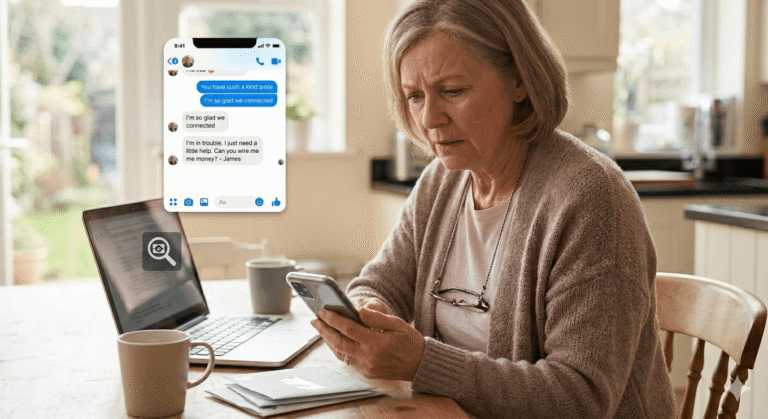
They said, “I Love You.” Then Came the Request for Money.

It started with a simple friend request on social media. A kind message. A photo of someone charming. Over the next few weeks, the conversations grew longer. The connection felt real. Then, one day, came the request, “I’m in trouble. I just need a little help. Can you wire me money?”
This scenario plays out thousands of times a year across the United States. It’s called a romance scam. And it doesn’t just hurt people’s bank accounts. It breaks their hearts, too.
What Is a Romance Scam?
A romance scam is exactly what it sounds like. Someone creates a fake identity, usually online, and uses it to build a romantic relationship with a real person. Once trust is established, they ask for money. Sometimes they disappear right after. Sometimes they string victims along for months or even years.
As Dr. Lucky Ogoo, a fraud prevention expert and LinkedIn author, explains, scammers create convincing fake profiles on social media and dating apps to build emotional bonds, eventually exploiting that trust to request money for manufactured crises. It sounds simple, but in practice, it’s a carefully calculated process designed to make you feel genuinely loved before you realize what’s happening.
The scammer might be posing as a military officer stationed overseas. A successful engineer working abroad. A widow who lost a spouse and is finally ready to love again. The profile looks real. The photos look real. The feelings start to feel real, too.
And that’s the whole point.
Why These Scams Work So Well
Romance scammers are patient. They don’t ask for money right away. First, they build some trust. Cybersecurity expert Erich Kron has written about how technology is making this even easier, noting that synthetic media and AI-generated personas are being used as virtual copycats capable of catfishing and romance scams on a massive scale. This means the person in the photo isn’t a real human being. They were drawn from scratch by a computer program to look like the perfect, trustworthy partner. If a profile seems too perfect, it might literally be a digital creation. That means scammers today may not even be using stolen photos of humans. They can generate an entirely convincing fake person with Artificial Intelligence (AI).
Here’s how the typical playbook works:
Step 1: The Setup. A scammer creates a profile with attractive photos, an interesting backstory, and just enough personal detail to seem real. They reach out, often on dating apps, Facebook, or Instagram.
Step 2: Love Bombing. They pour on affection fast. Constant messages. Compliments. “I’ve never felt this way before.” It moves quickly because they need to build emotional dependency before you have time to think clearly.
Step 3: The Isolation. Slowly, conversations shift away from the platform where you met. They suggest texting, email, and WhatsApp. This gets them off the platform’s safety monitoring.
Step 4: The Crisis. Something goes wrong. A medical emergency. A business deal gone bad. They’re stuck overseas and need money for a flight home. The request feels urgent. It feels personal. It feels like helping someone you love.
Antoinette King, an award-winning security professional who writes about cyber threats, warns that scammer pressure often spikes around emotional moments. King observes that scammers ramp up emotional manipulation and love bombing around holidays like Valentine’s Day, using AI-enhanced messages to demand money for fake emergencies or investments. She explains that holidays aren’t just celebrations anymore; for scammers, they’re opportunities.
The Numbers Are Staggering
According to the FBI’s 2024 report, the most recent full-year data available, romance scams resulted in over $672 million in losses across nearly 18,000 reported cases. Security experts note that for every person who reports a scam, many others remain silent due to embarrassment. While we wait for the final 2025 numbers, security experts agree that these scams are only becoming more frequent and harder to spot. Keep in mind that we are just talking about the people who reported it. Many victims never come forward out of embarrassment or grief.
The Federal Trade Commission (FTC) reports that median losses from romance scams range from $2,000 to $2,200 per victim, though this figure rises significantly for older adults, who are often targeted for their retirement savings. According to the FTC’s Consumer Sentinel Network, in the first nine months of 2025 alone, losses surpassed $1.16 billion, a 22% increase over the same period the prior year. For older adults, the numbers are often higher. These aren’t just dollars lost. For many people, this is retirement savings. Emergency funds. Money set aside for their kids.
Red Flags You Should Know
The FBI has published a list of warning signs worth memorizing. Watch out for someone who:
- Avoids video calls or always has a technical excuse for why the camera doesn’t work. Tip: If they agree to a call, ask them to slowly wave their hand in front of their face. Current AI deepfakes often glitch or look blurry when something moves between the camera and the face.
- Pushes you to move off a dating app to private messaging quickly
- Claims to be wealthy but suddenly needs financial help.
- Has a story filled with tragedy (sick family member, business disaster, stuck overseas, etc.)
- Asks for money via gift cards, wire transfer, or cryptocurrency, which are all nearly impossible to trace or recover
One of the best ways to protect yourself is to run a digital background check on a photo (technically called a reverse image search). Think of it like a search engine, but instead of typing words, you hand it a photo and ask, “Have you seen this person anywhere else?” If someone sends you photos, drag them into Google Images to see if they appear elsewhere. Scammers frequently steal photos from real people’s public profiles.
The FTC puts it simply. Never send money or gifts to someone you haven’t met in person. No matter how real the connection feels. No matter how urgent the situation seems.
How to Protect Yourself and the People You Love
None of this means you have to live in fear of meeting people online. Most people aren’t scammers, but a few smart habits go a long way.
Verify before you trust. Ask for a video call. If they keep saying no, that’s a red flag. Real people can video chat.
Talk to someone. Scammers work best in isolation. If you’re developing a strong online relationship, mention it to a friend or family member. A fresh set of eyes often catches things you might miss.
Never send money. The FTC is clear on this. If someone you’ve only met online asks for money, stop. It doesn’t matter how convincing the story is.
Search their photos. Use Google Images or TinEye.com to check whether their profile picture is stolen. Why? TinEye is a specialized tool that can often find a photo, even if the scammer changed the colors or cropped it to hide it from Google.
Trust your gut. If something feels off, it probably is.
If It’s Already Happened
First, this is not your fault. Romance scammers are skilled manipulators. They do this for a living. You were targeted because you are kind, not because you are naive.
Here’s what to do right away:
Stop all contact. Block them on every platform.
Contact your bank immediately. If you sent money via wire transfer or a bank account, call your bank the same day. The faster you act, the better the chance of stopping or reversing a transfer.
Report it. File a complaint at IC3.gov(the FBI’s Internet Crime Complaint Center) and at ReportFraud.ftc.gov. The FBI’s Recovery Asset Team has helped freeze fraudulent transfers in some cases, but speed is everything. The 2024 IC3 Report shows just how widespread these crimes are, and every report helps law enforcement track patterns and build cases.
Get support. The emotional impact of a romance scam can feel like a real breakup, because in a way, it is. Many victims describe grief, shame, and confusion. Speaking to a counselor or a support group can genuinely help.
The “Common Sense” Rule. If you are ever unsure, try the Coffee Test. Ask yourself. If a stranger walked up to me in a coffee shop and told me this exact same story, would I hand them my wallet? If the answer is No, then don’t send the money online either.
You Already Have What It Takes
Here’s the thing about romance scams. They work because they target something real in all of us. The desire for connection. The instinct to help someone in need. Those aren’t weaknesses. They’re what make us human.
But awareness is a shield. When you know how these scams work, you’re harder to fool. When you know the red flags, you catch them earlier. When you know to report it, you help protect the next person.
Remember the scenario at the beginning of this article? That kind of story, based on patterns seen in thousands of FBI and FTC complaints, doesn’t have to end in loss. When you know what to look for, it can end with one simple click, block, report, or move on.
Share this with someone you love. The best protection for your family is making sure everyone knows what to watch out for.
Help Protect Someone You Love
Scammers thrive on silence, but awareness is their greatest enemy. If you found this article helpful, please share it with a friend, a parent, or a grandparent. One simple conversation could be the shield that protects their heart and their hard-earned savings.
Want more “no-jargon” safety tips delivered to your inbox? [Join Our Newsletter]
Sources:
- FBI Romance Scams Page: https://www.fbi.gov/how-we-can-help-you/scams-and-safety/common-frauds-and-scams/romance-scams
- FBI Internet Crime Complaint Center (IC3) 2024 Annual Report: https://www.ic3.gov/Media/PDF/AnnualReport/2024_IC3Report.pdf
- FTC – What To Know About Romance Scams: https://consumer.ftc.gov/articles/what-know-about-romance-scams
- Federal Trade Commission – Consumer Sentinel Network Interactive Dashboard: https://public.tableau.com/app/profile/federal.trade.commission/viz/shared/GPBQNS9KW (Romance Scams data, Q1–Q3 2025, accessed February 2026)
- Erich Kron – “Are AI Influencers the Next Cybersecurity and Scammer Threat?” (LinkedIn Pulse): https://www.linkedin.com/pulse/ai-influencers-next-cybersecurity-scammer-threat-erich-kron-xnrme
- Dr. Lucky Ogoo – “Cyber Romance Scam: Love & Lies” (LinkedIn): https://www.linkedin.com/pulse/cyber-romance-scam-love-lies-dr-lucky-ogoo-9bf8e
- Antoinette King – “Beware of Love Scams!” (LinkedIn): https://www.linkedin.com/posts/antoinette-king-cissp-psp_lovescams-cybersecurity-cyberawareness-activity-7428184991202783232-LEMQ
This article is for informational purposes only. It does not constitute legal, financial, or professional security advice. For personalized guidance, please consult a qualified professional. The opening scenario is illustrative and based on common patterns documented in FBI IC3 reports, not a specific individual case.