The Virtual Kidnapping: What to Do When You Hear Your Child Screaming on the Phone

TL;DR (Too Long; Didn’t Read)
- Virtual kidnapping scams have evolved into a high-tech threat that targets your family’s most basic instinct: the need to protect your child.
- The Threat: Scammers use AI to clone your child’s voice, then call you pretending your kid has been kidnapped. They demand immediate payment.
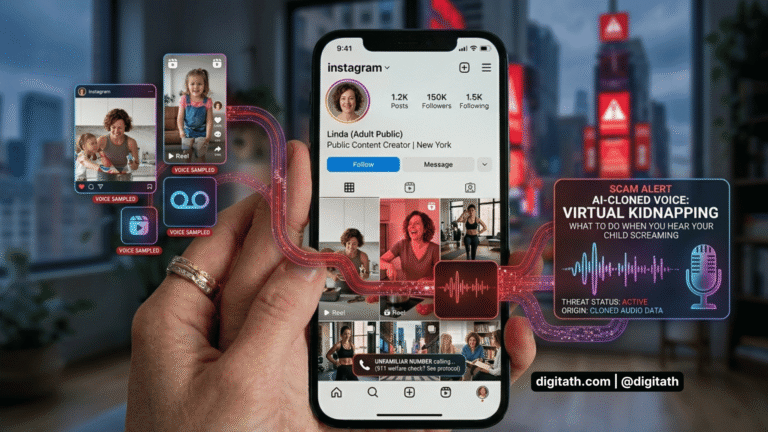
- How They Do It: They pull short audio clips from your child’s social media videos, feed them into a voice cloning app, and add background sounds like sirens and screaming to make it feel real.
- Stop It Now: Before moving forward, create a family-safe word. A word only your household knows. If an “emergency” call doesn’t include it, hang up and call your child directly.
The voice sounded exactly like her daughter.
Same tone. Same way of saying “Mom.” The same tiny catch in her voice when she was scared.
Linda answered the phone on a Tuesday afternoon. A man said her daughter had been taken. Her daughter, crying in the background, begged her not to hang up. The man said he needed $2,500 on Venmo. Right now. Or things would get worse.
Linda’s hands were shaking before he finished his second sentence.
She almost paid.
Her daughter was at soccer practice. Safe. Answering texts twenty minutes later, completely confused.
Linda had nearly wired money to a stranger because an AI had learned to sound like her child. To protect yourself, it’s vital to understand how this scam works.

How the Scam Actually Works (Modus Operandi)
Here’s the part most people don’t know: the scammer doesn’t need much to pull this off.
A 3-second video on your kid’s Instagram. A TikTok clip. A voicemail your child left on a public profile. That’s enough audio for today’s voice-mimicking software to build a convincing copy of your child’s voice. It can say anything the scammer types in.
Then they layer in background noise. Sirens. Crying. The sound of a struggle. Not because it’s real, but because panic is the whole point. The moment you hear your child screaming, your brain stops thinking clearly. That’s not a weakness. That’s just human. And these scammers know exactly how to use it. InvestigateTV documented multiple families targeted this way in early 2026 alone.
The ransom demand always comes fast, and it’s almost always through a payment app. Venmo. Zelle. Wire transfer. Methods that are hard to reverse and nearly impossible to trace once the money moves. Virtual kidnapping is just one of the AI scams now targeting families, and it’s spreading fast.
According to the Federal Trade Commission’s 2023 consumer alert on AI family emergency schemes, scammers need only a short audio clip from social media to clone a voice and build a fake emergency call. The FBI notes that these calls typically come from unfamiliar area codes, often international, and the “kidnapper” works hard to keep you on the line so you can’t call your child independently.
That’s the play. Now, let’s look at why it works so well.
Why It Works So Well (Red Flags from the Case File)
Your brain is running threat-assessment calculations the moment you hear a scream on the phone. It’s not looking for inconsistencies. It’s looking for escape routes.
Scammers know this. They use three psychological levers every single time:
Urgency. “You have ten minutes.” “If you hang up, she gets hurt.” The clock is always ticking because a panicked person doesn’t verify.
Authority. Many calls may include a fake “law enforcement officer” who takes over the conversation. Badges. Case numbers. Official-sounding language. The goal is to replace your own judgment with someone else’s.
Familiarity. The voice that sounds like your child. This one is the hardest to shake, even after you know it’s fake. Your gut tells you that’s your kid. AI made your gut wrong.
Detective’s Note: In the field, we call this “Amygdala Hijacking.” They aren’t talking to your brain. They are talking to your survival instinct. Once that kicks in, logic takes a back seat. That’s exactly what they’re counting on.
The whole thing is designed to get you off the phone with your child and on the phone with them. They only win if you don’t verify.
What to Do the Moment It Happens (The Defense Protocol)
Stay on the line if you can. Keep them talking. The more time they spend managing you, the more time someone else has to reach your child. Bitdefender and ConnectSafely both specifically recommend this. One person manages the scammer while another contacts the child on a second device.
Critical: Mute your microphone the moment you pick up a second device. If you’re crying, yelling, or panicking out loud, the scammer uses that to adjust their script and keep you off balance. Staying silent on the line is more powerful than staying scared.
While you keep them on the phone, do this:
- Hand your phone to another adult in the room. Let them handle the scammer while you take a second device.
- Call or text your child directly on their known number. One message. “Are you okay?” That’s it. Don’t explain. Don’t panic them.
- Check their location on your family sharing app (Google Family Link, Apple Family Sharing) if you have it set up.
- Contact their school, friend’s parent, or wherever they said they’d be. A 90-second phone call can end this.
If you cannot reach your child within a few minutes, call local police for a welfare check. Not the kidnapper’s number. Legitimate law enforcement will never demand payment over the phone or tell you not to call 911.
The FBI specifically recommends: try to slow the situation down, ask to speak directly to your child, and request proof of life that only your child would know, not a scripted line, but a real, personal detail. A scammer controlling an AI can’t answer “What did we have for dinner on your birthday last year?”
How to Make Your Family Harder to Target
Here’s something worth doing before you put this article down.
Step 1: Set a family safe word. Right now. It doesn’t have to be clever. “Pineapple.” “Green truck.” Anything unusual. If someone calls claiming to have your child, they must say that word, or you hang up and verify independently. Drill it like you’d drill a fire escape plan. McAfee and Global Guardian both flag this as the single most effective defense against voice cloning scams.
Step 2: Make your kids’ social media private. Not just their accounts. Their videos. Their voice. Scammers mine public posts for audio samples. A private account is much harder to harvest.
Step 3: Limit public video of your kids. The less publicly available voice audio there is, the less material a cloning tool has to work with. This isn’t about never posting. It’s about being intentional. If you’re not sure what your kids are sharing, start with the 7 things kids should never post online.
Step 4: Talk to your kids about this. Not to scare them. To prepare them. Tell them: “If anyone ever calls me pretending to be you in trouble, I have a safe word. Don’t worry, I’ll always verify before I panic.”
That conversation takes three minutes. It could save thousands of dollars and a lot of terror.
Do This Today (5 Minutes)
Pick a safe word. Text it to every adult in your immediate household. Save it somewhere private.
That’s it. That’s today’s action.
The other steps matter too: private accounts, location sharing, talking to your kids. But none of them work if you don’t have a word that a machine can’t guess.
Linda got lucky. Her daughter happened to answer a text. Not everyone does.
Create the word today.
Frequently Asked Questions
My kid doesn’t post videos online. Can they still clone his voice?
It’s harder, but not impossible. A voicemail, a video posted by a friend, or even a recording from a school event can be enough. The risk is lower if your child isn’t posting publicly, but “hard to clone” is better than “easy to clone.” It’s still worth making their accounts private.
Yeah, but I’d know my own kid’s voice if something sounded off, wouldn’t I?
Probably not in the moment. Today’s voice cloning tools are genuinely convincing, especially on a phone where audio quality is already compressed. Families who’ve been through this say the voice was “perfect.” The safe word is your backup for the moments when your ears aren’t enough.
What if I already paid? Is the money gone?
Possibly, but act fast. Contact your bank or payment app immediately and report it as fraud. Venmo, Zelle, and wire transfers have very short reversal windows; call within minutes if you can. Then file a report with the FBI’s Internet Crime Complaint Center at ic3.gov and your local police. Even if you can’t get the money back, your report helps law enforcement track patterns.
What if they won’t let me speak to my child?
That’s a red flag. Legitimate kidnappers don’t refuse proof of life; they use it as leverage. A scammer running a voice-cloning operation can’t generate real-time answers to personal questions. If they refuse to let you speak to your child, hang up and call your child directly. If you genuinely cannot reach your child and believe there may be a real emergency, call 911 immediately, not the number that called you.
Should I keep quiet about this if it happens to me? I’d be embarrassed.
No. Report it even if you didn’t pay, even if you figured it out quickly. The FBI’s IC3 uses reports to track these operations across state lines. Your report could be the link that connects calls in three different states to one criminal group. There’s nothing to be embarrassed about. These scams are professionally designed to beat smart, careful people.
AI scammers are getting better. Your defense needs to be too.
I put together a free assessment called the Digital Open Door Audit. Answer 6 questions. Get your threat verdict. Know exactly where your family is exposed before someone else does.
Sources
- Federal Bureau of Investigation. “Virtual Kidnapping.” FBI.gov. https://www.fbi.gov/news/stories/virtual-kidnapping
- Federal Bureau of Investigation. Internet Crime Complaint Center (IC3). ic3.gov. https://www.ic3.gov/
- Federal Trade Commission. “Scammers Use AI to Enhance Their Family Emergency Schemes.” FTC Consumer Alert, March 2023. https://consumer.ftc.gov/consumer-alerts/2023/03/scammers-use-ai-enhance-their-family-emergency-schemes
- Federal Trade Commission. “Scammers Use Fake Emergencies to Steal Your Money.” FTC Consumer Articles. https://consumer.ftc.gov/articles/scammers-use-fake-emergencies-steal-your-money
- ConnectSafely. “Virtual Kidnapping Scams.” ConnectSafely.org. https://connectsafely.org/virtualkidnapping/
- Bitdefender. “Virtual Kidnapping Scams.” Bitdefender Hot for Security Blog. https://www.bitdefender.com/en-us/blog/hotforsecurity/virtual-kidnapping-scams
- Global Guardian. “Virtual Kidnapping Prevention.” GlobalGuardian.com. https://www.globalguardian.com/global-digest/virtual-kidnapping
- McAfee. “Artificial Imposters: Cybercriminals Turn to AI Voice Cloning for a New Breed of Scam.” McAfee Blog. https://www.mcafee.com/blogs/privacy-identity-protection/artificial-imposters-cybercriminals-turn-to-ai-voice-cloning-for-a-new-breed-of-scam/
- InvestigateTV. “AI Voice Cloning Scams Target Families With Fake Kidnapping Calls.” January 23, 2026. https://www.investigatetv.com/2026/01/23/ai-voice-cloning-scams-target-families-with-fake-kidnapping-calls/
Disclaimer: This article is for educational and informational purposes only. It does not constitute legal or law enforcement advice. If you believe a kidnapping is in progress, contact 911 immediately. Digitath LLC makes no guarantee that any strategy will prevent all scams or criminal activity. The story of Linda and her daughter is illustrative. It does not depict a specific individual or real case, but reflects patterns documented in FBI and FTC warnings about virtual kidnapping scams.