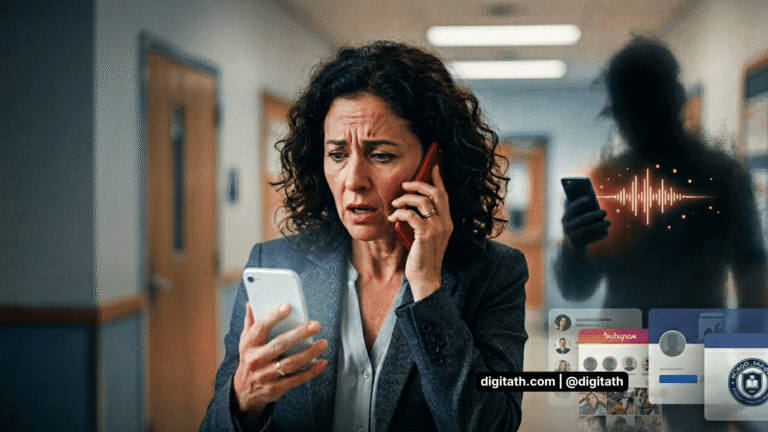
“I Got in Trouble at School” — How AI Is Targeting Parents

TL;DR (Too Long; Didn’t Read)
- The Threat: Scammers use AI to clone voices, fake school emails, and generate deepfake videos to trick busy parents into sending money or handing over personal information.
- How They Do It: They pull audio and photos from your family’s social media to make the scam feel personal — then hit you when you’re distracted, rushed, and emotionally vulnerable.
- Stop It Now: Go to your Instagram or Facebook privacy settings right now. Set your posts and tagged photos to “Friends Only.” This closes the easiest door they walk through.
The call came in at 2:47 PM on a Tuesday.
Linda was in the middle of a meeting when her phone buzzed. She stepped out to answer. The voice on the other end was her son’s. Same tone. Same cadence. Even the way he said “Mom” — slightly rushed, slightly embarrassed.
“I got in trouble at school. There’s a fee. I need $400 on a gift card before they release me.”
She almost hung up to call the school. Almost.
Instead, she sent the gift cards. And when she called her son twenty minutes later from the parking lot, he picked up from home. He’d been there all afternoon.
Linda’s son was fine. The voice she heard was not her son’s.
Why AI Scams Work So Well on Parents Specifically
Here’s what scammers figured out: parents carry the most powerful emotional trigger in the world. Their kids. And they’re also the busiest people in any room.
That combination is worth exploiting.
Generative AI (think voice mimicking software, also known as AI voice cloning, and realistic fake video technology, also known as deepfakes) can now produce a convincing copy of your child’s voice from as little as three seconds of audio. That’s shorter than a TikTok intro. Shorter than a school play clip. Shorter than the video you posted of your daughter’s birthday last month.
Scammers don’t need access to your accounts. They just need what’s already public.
According to the Federal Bureau of Investigation’s Internet Crime Complaint Center 2025 Internet Crime Report, the IC3 received over 1 million complaints in 2025, with total losses reaching approximately $20.9 billion. For the first time, the report included a dedicated section on AI-assisted crimes: 22,364 complaints tied directly to AI-enabled scams, with documented losses of approximately $893 million, and those are just the reported cases. Most victims never file a report.
The three main attacks hitting parents right now follow a clear pattern: fake school communications, voice cloning emergency calls, and investment traps dressed up as financial planning for families.
Modus Operandi 01: Fake School Emails and Texts
The email looks legitimate. The school’s logo. The principal’s name. A real-sounding subject line: “Urgent: Outstanding Balance — Action Required.”
The message tells you your child has an unpaid fee, a disciplinary issue, or a required form submission — and that failure to respond immediately will have consequences. A link is included. A payment portal or sometimes just a reply address.
This is AI-assisted phishing (also known as fake message scamming), and it’s gotten harder to catch because the messages are now personalized. Scammers scrape your child’s name from school websites, social media posts, and parent Facebook groups. They know which school your kid attends. Sometimes they know the teacher’s name too.
The urgency is the weapon. A parent who gets a message about their child at 10:30 AM during a workday doesn’t have twenty minutes to verify. They click. They fill in a form. They hand over their credit card or their personal information — and they move on, not knowing what just happened.
Red flags to watch for:
- The email asks for gift cards, wire transfers, or Zelle as payment
- The reply address doesn’t match the school’s official domain exactly (look for extra letters or swapped characters)
- The message creates a tight deadline with consequences attached
- There’s no option to call and verify — only a link or a reply
What to do instead: Call the school directly using the number saved in your phone or printed in your school’s handbook. Not a number in the email. Never a number in the email.
Modus Operandi 02: Voice Cloning and the Family Emergency Call
Linda’s story isn’t unusual. The Better Business Bureau has documented a sharp rise in virtual kidnapping scams, and AI voice cloning has made them significantly more convincing.
The formula is consistent: a panicked call, a recognizable voice, an urgent request for untraceable funds (gift cards, crypto, or wire transfer). The goal is to get money moving before you have time to think.
I covered exactly how scammers source the audio, the three psychological levers they use, and the full defense protocol in The Virtual Kidnapping: What to Do When You Hear Your Child Screaming on the Phone. If you have kids at home, that post is worth five minutes of your time.
The short version: the defense isn’t sharper ears. It’s a family code word — one phrase only your family knows. Set one up tonight. It takes two minutes.
Modus Operandi 03: Investment Traps Built for Parents
This one moves slower. And it costs more.
According to the FBI’s 2025 Internet Crime Report, investment fraud accounted for the highest total losses of any crime category tracked by the IC3, at approximately $8.65 billion. A significant portion of those losses came from scams that started with social media ads, fake online communities, and AI-generated celebrity endorsements.
The pitch is always tailored. You’re a parent. You’re thinking about college tuition, retirement, your kid’s future. A targeted ad shows up — sometimes featuring a well-known face (which is now easily faked using deepfake technology) promoting a crypto platform or a high-return investment opportunity designed for “family financial security.”
Some of these run what investigators call pig-butchering schemes (also known as trust-building investment fraud): months of conversation, small early returns to build confidence, and then one large “opportunity” that disappears along with everything you put in.
The Defense Protocol: What to Actually Do
The good news is that none of this requires you to become a tech expert. Most of what stops these scams is behavioral, not technical.
Today (5 minutes or less):
- Open Instagram or Facebook. Go to Settings. Set your posts and tagged photos to “Friends Only.” This doesn’t make you invisible — but it removes the easiest source of audio and photo material scammers use to personalize attacks.
- Pick a family code word. One phrase. Share it with your kids and your partner tonight. Anyone can ask for it. If the person on the other end of an emergency call can’t say it, hang up.
This week:
- Set up two-factor authentication (also known as 2FA) on your email account. This means even if someone gets your password, they can’t get into your account without a second code sent to your phone. Here’s exactly how to turn it on — it takes about five minutes.
- Talk to your kids about voice cloning. Tell them that someone could call them pretending to be you, and that the family code word is how they’d know it’s really you.
- Check your school’s official contact information and save it directly in your phone. Not from an email. From the school’s official website or your child’s enrollment paperwork.
Red flag checklist — stop and verify any time you see:
- Urgency paired with an unusual payment method (gift cards, Zelle, crypto, wire transfer)
- A request that involves your child’s safety and money at the same time
- A voice that sounds right, but something feels off in the background
- An email from a school, government agency, or financial institution that includes a link instead of asking you to log in directly
The families who dodge these scams aren’t more tech-savvy than everyone else. They’ve just built one habit: pause before you act. Even sixty seconds is enough to break the spell.
And if you want one more tool in your pocket, this one is worth bookmarking: The “Cupcake Trick” — One Sentence That Catches AI Phone Scammers.
Most families aren’t careless. They just don’t know where their open doors are. The Digital Open Door Test is a free assessment built from real investigative patterns. It shows you exactly where your family is most exposed — and what to fix first. No tech background needed.
Frequently Asked Questions
I don’t post videos of my kids online. Can they still clone a voice?
Yes — but it’s significantly harder. If your child has never appeared in a public video, there’s no obvious audio source for cloning. That said, school event footage, videos shared by other parents, and even group chats can sometimes surface audio. The code word defense works regardless of how the audio was sourced.
Yeah, but I’d know if something sounded off, right?
Honestly? Maybe not. Current AI voice cloning tools can replicate vocal tone, cadence, and emotion with high accuracy. The FTC’s guidance specifically notes that even people who listen carefully often can’t detect the difference. This is why the family code word matters more than your ears.
What if I already clicked a link in a fake school email?
Don’t panic. Close the browser tab immediately. If you entered any personal information or payment details, call your bank right away and let them know. Change the password to any account that uses the same credentials. If you’re not sure what was compromised, this post walks through exactly what to do in the next 24 hours.
How do I tell if an investment opportunity online is real?
The clearest sign of a scam is pressure to move fast combined with an unusual payment method. Legitimate investment platforms don’t ask for crypto transfers or wire payments to a personal account. If a social media ad is what pointed you there, that’s worth pausing on. The FBI recommends verifying any investment opportunity through the SEC’s EDGAR database at investor.gov before sending a single dollar.
What if my child gets one of these calls pretending to be me?
The same playbook works in reverse. Teach them the code word, and tell them that if someone calls claiming to be you with an emergency, they should hang up and call your actual number before doing anything. Tell them it’s okay to hang up. That’s not rude. That’s smart.
Where do I report this if it happens to me?
File a report at IC3.gov (the FBI’s Internet Crime Complaint Center) and at ReportFraud.ftc.gov. Also, notify your local police department. Even if nothing comes of the individual report, the data helps investigators identify patterns and shut down larger operations.
Sources & References
- Federal Bureau of Investigation — Internet Crime Complaint Center (IC3)
- 2025 Internet Crime Report
- Published: 2025
- URL: https://www.ic3.gov/Media/PDF/AnnualReport/2025_IC3Report.pdf
- Federal Trade Commission (FTC)
- Consumer Alert: Scammers use AI to enhance their family emergency schemes
- Published: March 2023 (AI voice cloning alert, applicable to 2025 patterns)
- URL: https://consumer.ftc.gov/consumer-alerts/2023/03/scammers-use-ai-enhance-their-family-emergency-schemes-heres-what-you-can-do
- Better Business Bureau
- BBB Scam Tracker — Virtual Kidnapping / AI Voice Scam Reports
- Published: Ongoing (accessed 2025)
- URL: https://www.bbb.org/scamtracker
Disclaimer: This article provides general educational information about AI-assisted scams and family cybersecurity. It does not constitute legal, financial, or cybersecurity consulting advice. For specific security concerns affecting your family or finances, consult qualified professionals. Information is accurate as of May 2026 but may become outdated as technology evolves. Implementation of any security measure is at your own risk.
The story of Linda and her son is illustrative. It does not depict a specific individual or real case, but reflects patterns documented in FBI and FTC warnings about AI voice cloning and virtual kidnapping scams.